Signal feed active Latest transmission · 2 days ago Threat level · Elevated
CMMC · NIST · HIPAA aligned EST · 09:00 – 18:00
Cyber intelligence · Updated weekly

Signal

Cutting through the noise · Intelligence for a resilient future

Recent transmissions

SHOWING 003 OF 003
Prelude · Mental model

Signal-to-Noise: cutting through the static

Why SNR is the right mental model for the modern information landscape — and what happens to a society that loses the signal.

Foundation framework

The 12 Commandments of Cybersecurity: 2026 Edition

A prioritized framework for digital resilience designed to survive high-speed, AI-driven threats.

Threat briefing

Deepfake threats & countermeasures · 2025–2026

Generative AI has weaponised audio, video, and synthetic identity. A field guide to the new social-engineering surface and how to defend against it.

Signal-to-Noise: cutting through the static

The concept of Signal-to-Noise Ratio (SNR) is a perfect metaphor for the modern information landscape. In audio, the “signal” is the voice you want to hear and the “noise” is the static or traffic ruining the take. In the digital age we aren’t fighting acoustic static — we are fighting informational static.

I

Information overload as background noise

In a recording, “noise” is anything that isn’t the primary subject. Today, we live in a state of constant ambient noise — just as traffic rumble makes a speaker hard to understand, the sheer volume of notifications, clickbait, and endless scrolling creates a high “noise floor.”

When the background noise of low-value information is too high, it becomes physically and mentally exhausting to isolate the signal — truth, deep learning, or meaningful connection.

Floor check

Audit the inputs you allow into your day. Each notification, feed, and channel raises the noise floor for everything else.

II

The distance problem

In audio, the closer the mic is to the mouth, the better the SNR. In our information landscape, we are often too “distant” from primary sources — we consume third-hand interpretations, screenshots of tweets, or AI-generated summaries of summaries.

The further you get from the original source of a fact, the more noise — bias, error, or sensationalism — enters the recording.

Source proximity

Before reacting to a claim, trace it to its primary source. One step closer to the mic raises the SNR more than any filter ever will.

III

Equipment hiss — algorithmic bias

Sometimes noise doesn’t come from the world; it comes from the equipment itself. Even in a silent room, a cheap preamp will add a hiss to the recording.

The platforms we use to gather information — social media algorithms and search engines — are our equipment. They add their own internal noise by prioritizing engagement over accuracy, effectively layering static onto our perception of reality.

Gear check

Treat each platform as a piece of equipment with a known hiss. Choose tools whose incentives align with signal, not engagement.

IV

The ratio — why it matters

SNR is a ratio, not an absolute value. You can improve your life in two ways: increase the signal by seeking higher-quality books, long-form journalism, and expert primary sources — or decrease the noise by unsubscribing, turning off notifications, and exiting noisy digital environments.

A clear life isn’t one without noise — that’s impossible — but one where the signal is so dominant that the noise becomes irrelevant.

Both sides

Work the numerator and the denominator. Adding signal without subtracting noise is a treadmill.

V

Cognitive overload at the individual level

When we are bombarded by noise, the brain’s gain control breaks. We experience decision fatigue and cynicism. If everything sounds like static, we eventually stop listening to anything at all — a state of information nihilism in which a person believes nothing is true.

Personal SNR

If you find yourself disbelieving everything by default, that’s not skepticism — it’s a symptom of overload. Reduce input volume before you decide what’s true.

VI

The collapse of shared reality

Society functions on a shared signal. When the noise becomes too loud, we lose the ability to agree on basic facts — climate data, election results, public-health guidance. The result is polarized echo chambers where different groups tune into different frequencies, making collective action impossible.

Civic SNR

Before debating conclusions, confirm you and the other party are receiving the same underlying facts. Most arguments are signal-mismatch problems, not value disputes.

VII

Case study — the public health crisis

Imagine a local government issuing a water-boil advisory after contamination — that is the signal. In a high-noise scenario, social media fills with rumours that the advisory is a conspiracy, bots post conflicting home remedies, and influencers post unrelated distractions.

Because the SNR is low, citizens cannot distinguish the life-saving signal from the static. People get sick not because the information wasn’t there, but because it was buried.

Cyber parallel

The same dynamic kills incident response. If your alert channel is also your meme channel, the breach notification gets buried with the cat photos.

VIII

Insights from Harari’s Nexus

In Nexus, Yuval Noah Harari explores how information networks — both historical and silicon-based — can lead to disaster if they value noise (engagement) over signal (truth). He argues that information is not the raw material of truth; it is the raw material of order — and that the easiest way to create order among humans is often through fiction rather than the messy, complicated truth.

Modern technology doesn’t just transmit information; it curates it. If the curation process favours noise because it is more addictive, society loses its ability to self-correct, eventually leading to the collapse of democratic institutions which rely on high-quality information to function.

Curation matters

The filter you choose is more consequential than the content you read. Audit your curators the way you audit your vendors.

IX

What happens if we don’t improve

If we fail to improve our informational SNR, we face three primary risks. Institutional decay: trust in science, journalism, and law evaporates because they are too quiet compared to the loud static of populist rhetoric. The rise of algorithmic authority: we stop thinking for ourselves and let curated noise dictate our choices, effectively losing our agency. Fragility: a society that cannot identify its real problems cannot fix them, leading to systemic collapse when a real crisis — a pandemic, an economic shift — hits.

Three risks

Decay, algorithmic authority, fragility. Track them as leading indicators in your own organisation, not just out in the world.

X

The four levels of degradation

Watch a single concrete fact dissolve as SNR drops. Level 1 — crystal clear: “The James Webb Space Telescope uses infrared astronomy to observe objects too old, distant, or obscured for Hubble.” Level 2 — low noise: subjective commentary (“super expensive”) and simplified metaphors (“heat vision”) crowd the technical accuracy.

Level 3 — medium noise: conflicting opinions, unrelated jargon (“Lagrange point”), and speculative misinformation (“looking for aliens”) start to bury the actual purpose. Level 4 — total static: emotional triggers, hashtags, conspiracy theories, and whataboutism completely overwhelm the signal. The original fact is now impossible to extract from the noise.

Noise floor

When an individual is exposed to Level 4 long enough, they lose the ability to recognise Level 1. That is the informational noise floor — when the background hiss of the internet is so loud that the truth sounds like just another random frequency.

XI

Why this matters for cyber

SNR isn’t just a media problem — it’s an operational one. Your SOC dashboard, your inbox, your vendor advisories, and your alert system are all SNR systems. Every false-positive alert, marketing email, and low-fidelity advisory raises the noise floor that real incidents have to climb above.

Operational SNR

Tune detection rules for fidelity, not coverage. A high-fidelity alert that wakes you twice a year is more valuable than ten alerts a day you’ve learned to ignore.

XII

The ZDT prescription

Increase the signal: primary sources, named analysts, written advisories with dates and authors. Decrease the noise: unsubscribe from vendor marketing dressed as research, mute channels that amplify rather than verify, and route operational alerts away from social spaces.

A clear security program isn’t one without alerts — that’s impossible — but one where the signal is so dominant the noise becomes irrelevant.

Closing

Signal is what we’re trying to publish here. Subscribe, share, and tell us what got through.

XIII

Information SNR — an illustrated example

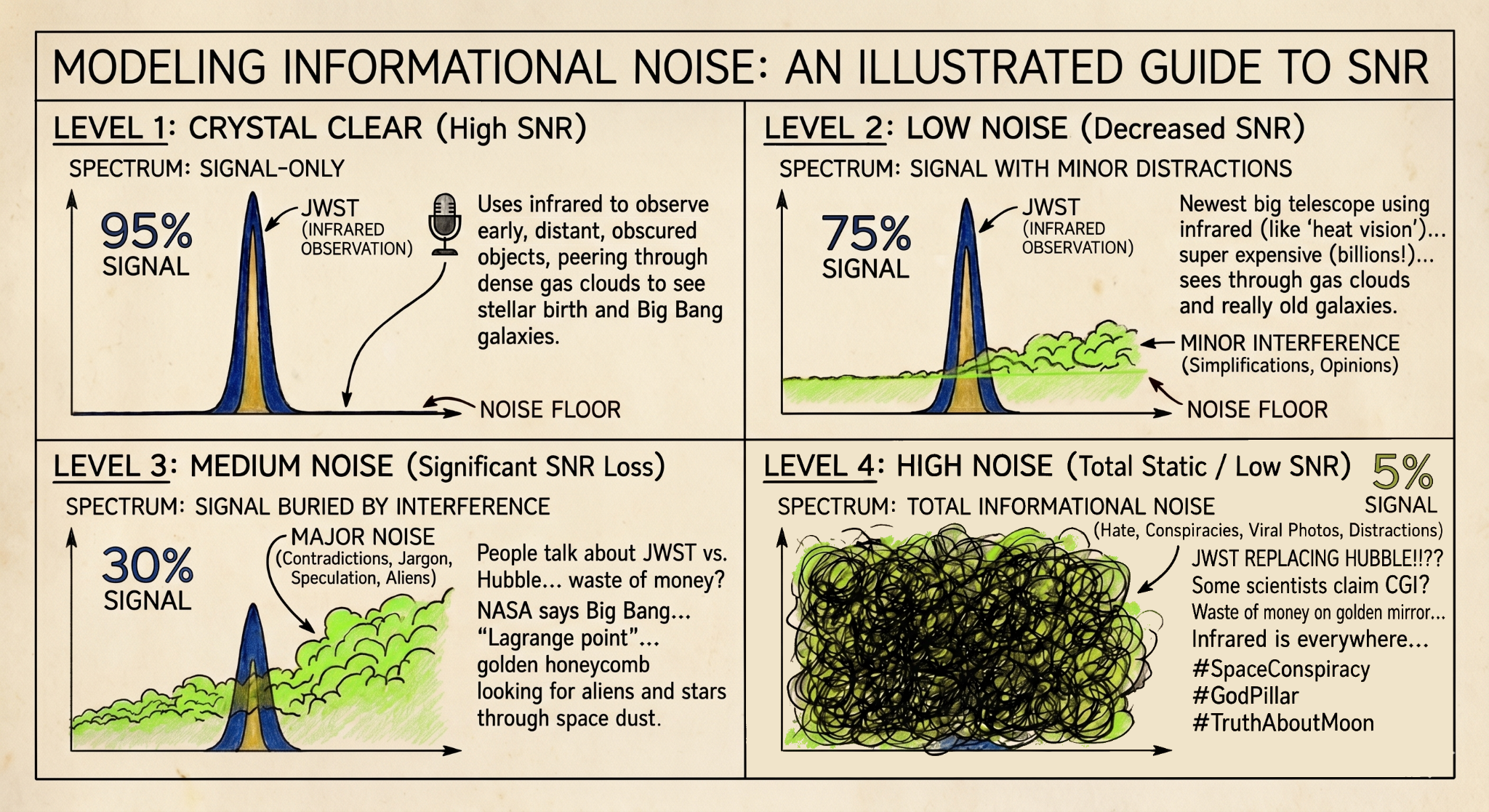
To illustrate how informational noise degrades a signal, take a single concrete scientific fact — the James Webb Space Telescope — and watch it dissolve as we decrease the SNR across four levels.

95% signal
Level 1 · Crystal clear

The signal

“The James Webb Space Telescope (JWST) uses infrared astronomy to observe objects too old, distant, or obscured for the Hubble Space Telescope. By capturing longer wavelengths of light, it can peer through dense gas clouds to see the birth of stars and the first galaxies formed after the Big Bang.”

75% signal
Level 2 · Low noise

Minor distractions

“The newest big telescope uses infrared — like heat vision — to see things Hubble missed. It’s super expensive (billions of dollars!) and sits far from Earth.” Subjective commentary and simplified metaphors begin to crowd the technical accuracy.

30% signal
Level 3 · Medium noise

Significant interference

“People are talking about Webb vs Hubble because of infrared light. Some say it’s a waste of money, but NASA says it sees the Big Bang. Parked at a ‘Lagrange point’ — sounds like science fiction. A giant golden honeycomb looking for aliens.” Conflicting opinions, unrelated jargon, and speculative misinformation start to bury the actual purpose.

< 5% signal
Level 4 · Total static

High noise

“JWST IS REPLACING HUBBLE!!?? Some scientists claim it sees the ‘beginning of time’ but is it just CGI? Billion-dollar golden mirror is out there while we have problems on Earth. #SpaceConspiracy #JWST #GodPillar.” Emotional triggers, hashtags, conspiracy theories, and whataboutism have completely overwhelmed the signal.
Modeling Informational Noise: an illustrated guide to SNR across four levels
FIG. 01 — Modeling informational noise across four levels of degradation. As the noise floor rises, the original signal becomes impossible to extract.
Noise floor

When an individual is exposed to Level 4 long enough, they lose the ability to recognise Level 1. That is the informational noise floor — when the background hiss of the internet is so loud that the truth sounds like just another random frequency.

The 12 Commandments of Cybersecurity

Defense perimeters have dissolved. In 2026, security is no longer about building higher walls — it's about identity integrity and resilience.

I

Protect identity above all

Identity is the new perimeter. Use phishing-resistant Multi-Factor Authentication (MFA) — hardware keys or passkeys — for every account. In 2026, static passwords are invitations to breach.

Protocol

Follow the rule of least privilege — give users only the specific access they need and nothing more.

II

Maintain absolute visibility

You cannot protect what you cannot see. Keep a live, automated inventory of every device, software package, and AI tool used by your team.

Visibility

Monitor machine identities — API keys and service accounts — that often go unchecked.

III

Assume the breach, build resilience

Stop asking "if" you will be hacked and start planning how you will survive it. Focus on time to remediate — the hours between detection and recovery — not just prevention.

Resilience

Keep immutable backups that cannot be deleted or altered by an attacker, and test your ability to restore critical systems in hours, not weeks.

IV

Patch based on active threats

Don't just patch everything on a calendar schedule. Prioritize fixing security holes that are known to be actively exploited by attackers in the wild.

48-hour rule

If a vulnerability is being used for real-world attacks, fix it within 48 hours. Everything else can follow the normal maintenance window.

V

Lead from the boardroom

Cybersecurity is a business survival issue, not just an IT task. Executive leadership and boards must take personal responsibility for security risk.

Governance

Treat cyber-readiness as a core part of the board's duty to protect the company and its customers — right alongside financial and legal oversight.

VI

Turn employees into a defensive layer

Your people are your best early-warning system. Move beyond boring compliance training and teach your team to spot modern threats like AI-generated deepfakes and voice cloning.

Culture

Make reporting suspicious activity frictionless and celebrated. Every early report shaves minutes off the blast radius of a real attack.

VII

Demand security from your partners

Your company is only as safe as the vendors you hire. Third-party breaches have roughly doubled in recent years, and attackers increasingly target the weakest link in your supply chain.

Vendor risk

Before signing a contract, verify suppliers follow the same high security standards you do — and monitor their access to your data continuously, not just at onboarding.

VIII

Guard the data, not just the network

Protect data throughout its entire life — at rest, in motion, and in use. The old model of a hardened network perimeter no longer maps to how modern businesses actually operate.

Crypto-agility

Use the strongest available encryption today and begin planning for quantum safety, so your data stays private even as computing power leaps forward.

IX

Filter the noise for real signals

Don't drown in data. Focus monitoring on high-fidelity signals — failed privileged logins, unauthorized changes to administrator roles, unusual data egress.

Detection

By ignoring the noise and watching the most critical events, you can catch attackers in the early stages — before real damage is done.

X

Enforce secure standards

Most breaches happen because of a simple misconfiguration, not a sophisticated zero-day. Establish a gold standard for how every computer and cloud service should be configured.

Drift control

Use automated tools to watch for configuration drift — when a setting is accidentally (or maliciously) changed and opens a hole — and auto-remediate where safe.

XI

Govern AI with clear rules

AI is a powerful tool, but it can leak your secrets if not managed. Create a clear policy for how your team may — and may not — use AI systems at work.

AI policy

Ensure sensitive company data never enters public AI models, and that any AI-driven decision with business impact is reviewed by a human.

XII

Make security a permanent habit

Security is a continuous cycle, not a one-time project. The threat landscape changes weekly; your defenses should too.

Cadence

Establish a weekly security cadence where leaders review current risks, check patching progress, and update defense plans. A culture of constant improvement is the only way to stay ahead.

Deepfake threats & countermeasures (2025–2026)

Deepfake technology has evolved from a niche digital novelty into a sophisticated weapon for cybercriminals. By leveraging generative AI to create hyper-realistic audio, video, and imagery, attackers are successfully targeting the “human layer” of security — where traditional technical defenses often fail.

I

Advanced social engineering (BEC 2.0)

The most direct threat to enterprises is Business Email Compromise evolved into vishing (voice phishing) and quishing (video phishing).

CEO fraud: attackers clone the voice or video of a high-ranking executive to authorise urgent, fraudulent wire transfers.

Case study

In 2024, a Hong Kong firm lost $25M after an employee was tricked into a video conference where every other “participant” was a deepfake version of their actual colleagues.

II

Identity fraud & synthetic personas

Cybercriminals are using Deepfake-as-a-Service (DaaS) to create entirely synthetic identities.

Account opening: fraudsters use AI-generated faces to bypass Know-Your-Customer (KYC) requirements at banks. Ghost employees: attackers use deepfakes during remote interviews to secure positions within companies, gaining internal access for corporate espionage or data theft.

Insider risk

Treat your hiring funnel as a security control. Identity verification doesn’t end at offer-letter signature.

III

Bypassing biometric security

Traditional biometric systems — facial recognition and voice authentication — are under siege.

Injection attacks: instead of holding a photo up to a camera, attackers inject synthetic media directly into the data stream of an authentication app. Presentation attacks: high-quality AI-generated imagery can now fool many standard liveness detection algorithms.

Stack reality

Static facial recognition alone is no longer a sufficient authentication factor. Layer with active liveness and device-bound credentials.

IV

Corporate disinformation & market manipulation

Deepfakes pose a reputational risk that can manifest as a cybersecurity incident.

Stock manipulation: a deepfake video of a CEO announcing a fake scandal or catastrophic product failure can trigger algorithmic trading and wipe out billions in market cap in minutes. Sabotage: fake audio of internal meetings can be leaked to damage brand trust or ruin M&A negotiations.

Comms drill

Pre-stage rapid-response statements and legal takedown contacts before you need them.

V

Technical countermeasures

Defending against deepfakes requires a defense-in-depth approach, combining technology with updated human protocols.

AI-driven detection — tools like Pindrop and Sensity analyse artifacts invisible to the human eye: unnatural blood-flow patterns in skin (photoplethysmography), inconsistent lighting, robotic vocal cadences.

Content provenance (C2PA) — the Coalition for Content Provenance and Authenticity standard attaches a “digital nutrition label” to media, cryptographically signing it at the moment of creation to prove its origin.

Active liveness detection — systems ask users to perform random actions (“follow the dot with your eyes,” “say a random phrase”) to ensure real-time human presence.

Blockchain for integrity — cryptographic hashes of official corporate media stored on a ledger let third parties verify whether a video has been altered.

Stack target

Pair detection at ingest with provenance at creation. Detection alone is a losing arms race.

VI

Organisational & procedural countermeasures

Zero Trust architecture — move away from implicit trust. Any high-value request (e.g. a wire transfer over $10k) must be verified through out-of-band communication: a separate, pre-established channel like a physical phone call or a secondary messaging app.

Shared secret protocols — similar to a duress code, teams can establish safe words or challenge-response questions that would not be found in public data (e.g. “What was the theme of last year’s off-site lunch?”).

Deepfake awareness training — teach employees to look for subtle glitches: unnatural blinking, lip-sync lag, emotional inconsistencies in video calls.

Incident response playbooks — companies must have a deepfake response plan ready, including pre-drafted PR statements and legal routes for rapid takedowns of fraudulent content.

People & process

The strongest control is a culture where verifying a request is faster than completing it.

VII

Regulatory & policy frameworks

The EU AI Act mandates that AI-generated content must be labelled as such. U.S. executive orders focus on the development of standards for watermarking and authenticating government-issued content.

Compliance horizon

Map your content workflow against C2PA and watermarking standards now — mandates are arriving faster than tooling.

VIII

The defense gap

The numbers are unflattering. Creation tools have outpaced defensive tooling on every axis.

Threat metric 2024–2025 trend Defense status
Prevalence3000% increase in online deepfakesLags behind creation tools
Cost to create< $5 for a convincing voice cloneDefenses cost thousands
Human detection44% average success rateHuman eye no longer reliable
Financial impact$500M+ lost annually in U.S.Rising exponentially
Reality check

Asymmetry favours the attacker. Closing the gap is a procedural and cultural problem first, technical second.

IX

Conclusion — the culture of verification

The era of “seeing is believing” has ended. As deepfake technology becomes cheaper and more accessible, the primary defense is no longer a better algorithm, but a culture of verification.

Organisations that implement multi-factor authentication for processes — not just logins — will be the most resilient against the next wave of AI-driven deception.

Closing

Verify the request, not the requester. Channels can lie; protocols don’t.